Mizen Head. Two faces in one day, foggy, sunny,
of Ireland's most south-westerly point.
 |
| Dunlough Bay |
 |
| You are here! |
Mizen Head, traditionally regarded as the most southerly point of mainland Ireland, had two faces for us last Tuesday morning. We’ve experienced all kinds of weather during our regular visits over the years, from scorching sunshine and pounding seas and now the fog.
On arrival, we thought we wouldn’t be able to see anything due to the deep fog. But by the time we had read our way through the various exhibitions, that fog had begun to shift, and the sun was starting to show. In any weather, perched on the edge of the Atlantic, Mizen Head is one of the most spectacular headlands on Ireland’s seaboard.
On arriving at Mizen, you'll find a pretty large car park with some great views (normally!) over the ocean. The entrance hall, including the ticket office and some exhibitions, is straight ahead. Here also, you find a café, shop and bathrooms. The indoor exhibitions, both by the entrance and down at the point, are fascinating.
 |
| Foggy morning |
Once you come out in the open, you have a range of cliff paths ahead of you. Perhaps the main one is more or less straight to the impressive footbridge. You may be fit enough to do all the pathways, but do try to get up to the amazing viewpoints over Dunlough Bay.
 |
| The story of the Fastnet Lighthouse is well told at Mizen, as in this illustration. |
In any case, you must not miss a stroll over that footbridge where you may well see seals far below. Continue straight ahead to the old signalling station, now a museum open to visitors. Quite a few more interesting displays here, including the lightkeeper at breakfast (though he hasn’t touched a bite since I was here last!
As many of you know, the 40th anniversary of the Air India bombing was marked recently at the memorial park in nearby Ahakista. Three hundred and twenty-nine people (208 of them Canadian) were murdered when the plane exploded off the West Cork coast.
But that wasn't the area's first disaster involving Canadians. I found this info on one of the many info panels at Mizen.
"HMHS Liandovery Castle, built in 1914 in Glasgow as RMS Llandovery Castle for the Union-Castle Line, was one of five Canadian hospital ships that served in the First World War. On a voyage from Halifax, Nova Scotia to Liverpool, England, the ship was torpedoed off southern Ireland, about 116 miles southwest of Fastnet on 27 June 1918.
The sinking was the deadliest Canadian naval disaster of the war. 234 doctors, nurses, members of the Canadian Army Medical Corps, soldiers and seamen died in the sinking and subsequent machine-gunning of lifeboats. Only 24 people, the occupants on a single life-raft, survived. The incident became infamous internationally and was considered, after the Armenian genocide, as one of the war's worst atrocities. After the war, the case of Llandovery Castle was one of six alleged German war crimes prosecuted at the Leipzig trials."
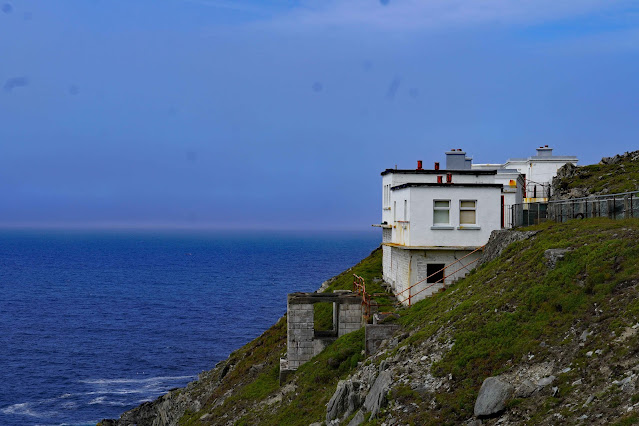 |
| No fog now! |
The nearby village of Crookhaven has had a distinguished history as the first and
last port of call for ships going between Northern European ports
and America. Over the centuries, ships stocked up here with provisions and bunkered. This drew radio pioneer Guglielmo Marconi to the West Cork village in the early 1900s, and he guided subsequent communications developments that made sea traffic more efficient and safer. Read more in Mizenhead.ie There is still a property in the village called Marconi House.
 |
| Bovine Balance. On the edge! |
After spending 90 to 120 minutes walking around the spectacular paths, why not drop into the Mizen Café, which offers a range of snacks, hot and cold drinks, and home-made treats including:
- Teas, coffee and hot chocolate
- Cold juices and soft drinks
- A variety of home baked produce, including cakes, brown bread, apple tart and more...
- Homemade soup and that West Cork favourite, seafood chowder
- Local mussels and fresh fish and chips
- A selection of freshly made sandwiches
- Whipped ice-cream cones, perfect for cooling down on a warm day
 |
As I drove down (R585). from Crookstown, the amount of flora growing on the roadside was
eye-catching. Early on, there were plenty of wild roses and more and more fuchia, meadowsweet
also, the further west I travelled. The area around Mizen, including Barleycove, has quite an
amount of flora, including some rare ones. This Sea Plantain is quite common on Mizen.
Short video Dunlough Bay
|


.jpg)


